Basic concepts of Hashing
In my data structures and algorithms course, I had a topic which gave me a general overview on how hashing helps to store and retrieve data efficiently. Some of the concepts fascinated me and I decided to implement them for recreation.
Some basic terms that I'll be using in my explanation are:
| Terms | Definitions |
|---|---|
| Key | An input. |
| Hashing | The process of taking an input key and generating a parameter which is used to store the key. |
| Hash Function | A function that is responsible for taking the key as input, processing it and providing an output that is used to store the key. |
| Bucket | A place where the key is stored. |
| Hash table | A table which stores all of the buckets. |
| Bucket index | An index or a reference to where the key is stored; or simply put, the address of the bucket in the hash table. |
| Collision | When one or more keys (input) produce the same bucket index (output), a collision is said to occur. |
| Overflow | When a hash table has reached the limit of how many keys it can store, adding any more elements will cause an overflow to occur. |
To resolve a collision, we use different collision resolution techniques. Three of them are:
Chaining
Important points to note
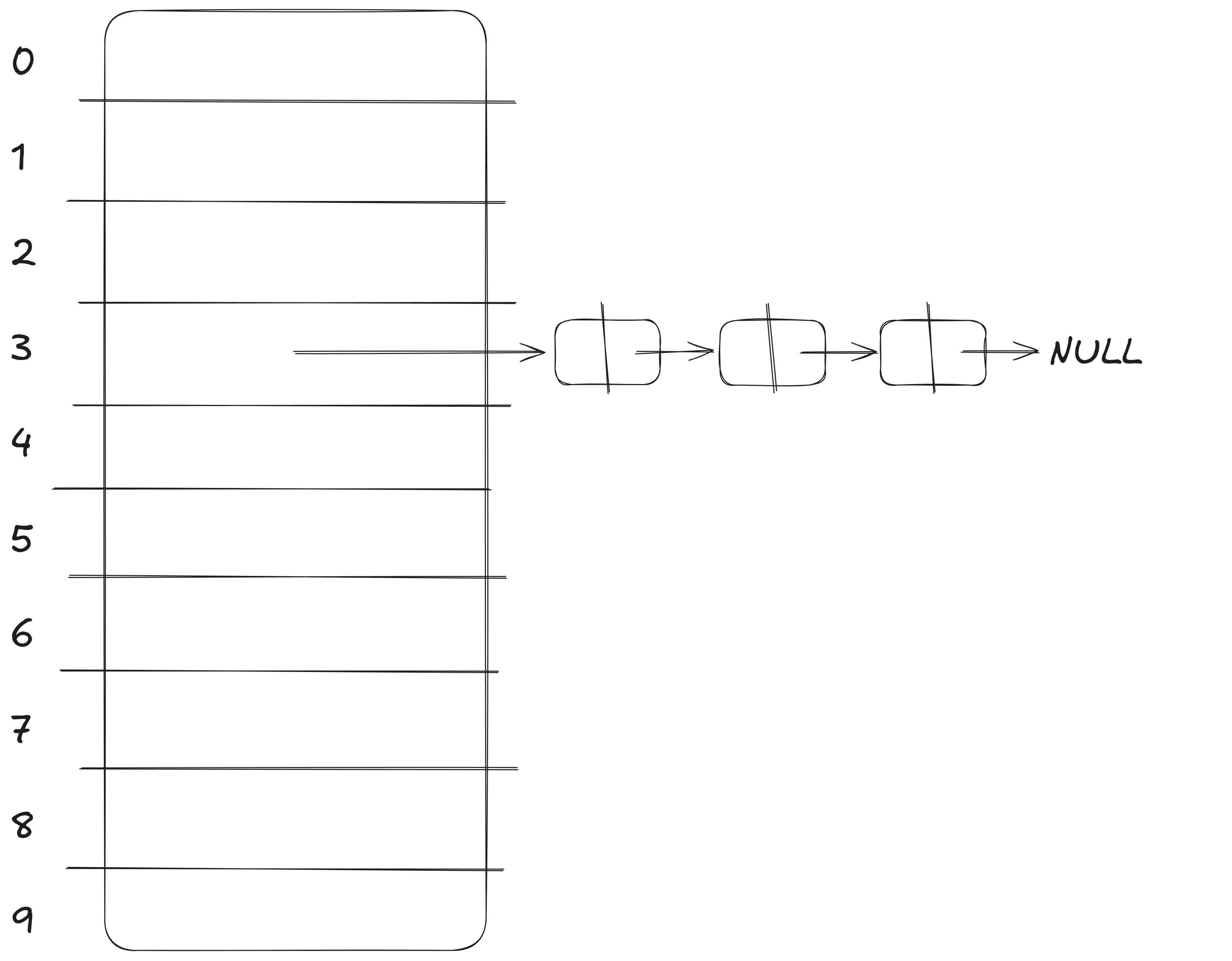
- This type of technique uses linked lists to store keys.
- When a collision occurs, one can simply add the incoming key to the linked list.
- This solution is able to dynamically store incoming keys without requiring us to manually resizing it.
- Each index of the hash table points to the head of the linked list that stores the most recent element of the bucket.
- Each element that is in the linked list points to the next element. If the current element is the last element, it will point to null.
Visual representation
C code
#include <stdio.h>
#include <stdlib.h>
#include <string.h>

#define MAX_INDEX 10

typedef struct bucket_t {
  char *data;
  struct bucket_t *next;
} bucket;

typedef struct bucket_index_t {
  bucket *index_ptr;
} bucket_index;

bucket_index table[MAX_INDEX];

void initialize_table() {
  for (int i = 0; i < MAX_INDEX; i++)
    table[i].index_ptr = NULL;
}

void push_key(char *word) {
  char *key = malloc(strlen(word) + 1);
  strcpy(key, word);
  int key_length = strlen(key);
  int hash_value = key_length % MAX_INDEX;

  bucket *new_entry = malloc(sizeof(bucket));
  new_entry->data = key;
  new_entry->next = NULL;

  if (table[hash_value].index_ptr == NULL) {
    table[hash_value].index_ptr = new_entry;
  } else {
    bucket *tmp = table[hash_value].index_ptr;
    new_entry->next = tmp;
    table[hash_value].index_ptr = new_entry;
  }
}

void print_hash_table() {
  for (int i = 0; i < MAX_INDEX; i++) {
    printf("Index %d: ", i);
    bucket *head = table[i].index_ptr;
    while (head != NULL) {
      printf("%s ", head->data);
      head = head->next;
    }
    printf("\n");
  }
}

void delete_hash_table() {
  for (int i = 0; i < MAX_INDEX; i++) {
    bucket *head = table[i].index_ptr;
    while (head != NULL) {
      bucket *tmp = head->next;
      free(head->data);
      free(head);
      head = tmp;
    }
    table[i].index_ptr = NULL;
  }
}

int main() {

  int limit = 100;

  initialize_table();

  while (limit--) {
    char buff[100] = {0};
    scanf("%99s", buff);
    push_key(buff);
  }

  print_hash_table();
  delete_hash_table();

  return 0;
}
Output
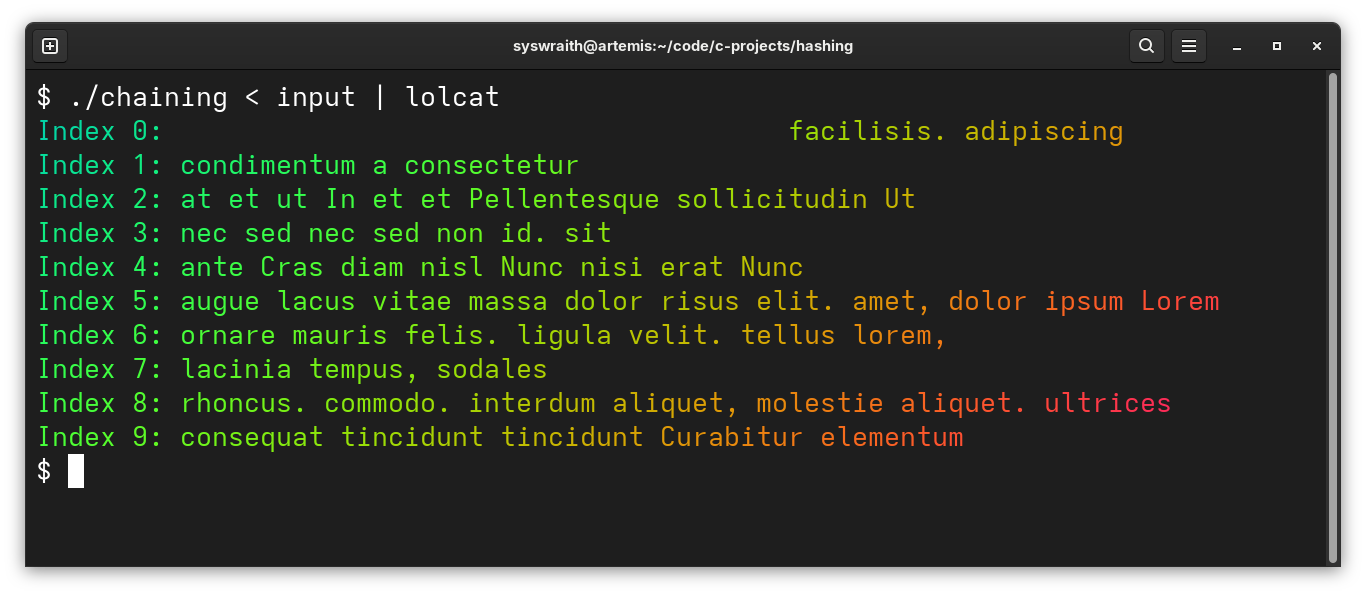 Since the hash function is
k % 10, the index for 0 and 10 are the same, thus the leading spaces.
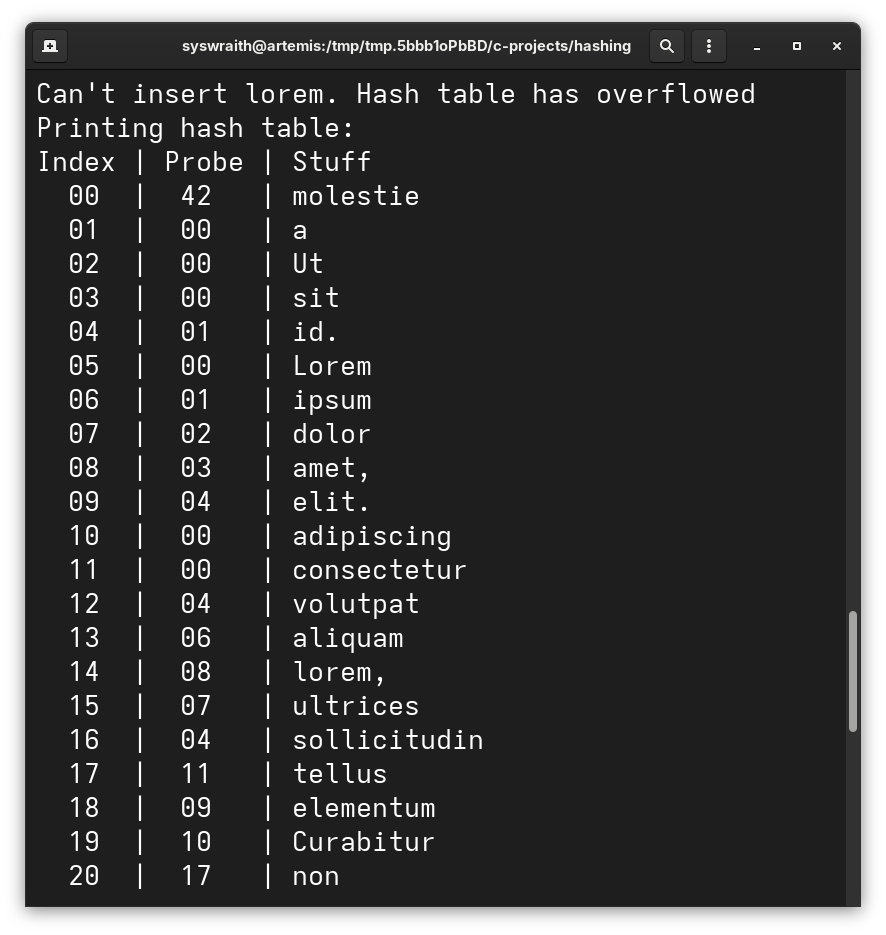
Linear Probing and Quadratic probing
- Both Linear and Quadratic probing use a simple index table structure.
- The hash table may be defined as a simple array that can hold the value and the probe number.
- The probe number is the number of tries/probes taken to search for an empty bucket.
- Since the table size is fixed, an overflow can occur.
Difference between linear and quadratic probing
- S = Table size
- N = Probe number
- x = Key value
| Differences | Linear Probing | Quadratic Probing |
|---|---|---|
| Hash function used | (hash(x) + N) % S |
(hash(x) + N*N) % S |
| Primary clustering | Occurs | Does not occur |
| Secondary clustering | Occurs | Occurs |
| Search time | Drastically increases | Increases gradually |
1. Linear Probing
#include <float.h>
#include <limits.h>
#include <stdbool.h>
#include <stdint.h>
#include <stdio.h>
#include <stdlib.h>
#include <string.h>
#include <time.h>

#define MAX 50

typedef struct bucket_t {
  char *data;
  int probe;
} bucket;

bucket *table[MAX];
void init_table();
int calc_index(char *word);
int probe(int bucket_index);
void create_element(char *key);
void delete_table();
void print_table();

void init_table() {
  for (int i = 0; i < MAX; i++)
    table[i] = NULL;
}

int probe(int bucket_index) {
  for (int i = 0; i < MAX; i++) {
    int circular_value = (bucket_index + i) % MAX;
    if (table[circular_value] == NULL) {
      return i;
    }
  }
  return -1;
}

int calc_index(char *key) {
  int index = strlen(key) % MAX;
  return index;
}

void create_element(char *word) {
  char *key = malloc(strlen(word) + 1);
  strcpy(key, word);

  int bucket_index = calc_index(key);
  int probe_value = probe(bucket_index);

  if (probe_value == -1) {
    printf("Can't insert %s. Hash table has overflowed\n", key);
    free(key);
    return;
  }

  int circular_value = (bucket_index + probe_value) % MAX;
  bucket *element = malloc(sizeof(bucket));
  element->data = key;
  element->probe = probe_value;

  printf("Inserting %s at index %d\n", key, circular_value);
  table[circular_value] = element;
}

void delete_table() {
  printf("Deleting table\n");
  for (int i = 0; i < MAX; i++) {
    if (table[i] == NULL)
      continue;
    free(table[i]->data);
    free(table[i]);
    table[i] = NULL;
  }
}

void print_table() {
  bool table_empty = true;

  for (int i = 0; i < MAX; i++) {
    if (table[i] != NULL) {
      table_empty = false;
      break;
    }
  }

  if (table_empty) {
    printf("Nothing to print. Table is empty\n");
    return;
  }

  printf("Printing hash table:\n");
  printf("Index | Probe | Stuff\n");
  for (int i = 0; i < MAX; i++)
    if (table[i] != NULL)
      printf("  %.2d  |  %.2d   | %s\n", i, table[i]->probe, table[i]->data);
}

int main(void) {

  init_table();

  int limit = 100;
  while (limit--) {
    char buff[100] = {0};
    scanf("%99s", buff);
    create_element(buff);
  }

  print_table();
  delete_table();
  print_table();

  return 0;
}
2. Quadratic Probing
#include <float.h>
#include <limits.h>
#include <stdbool.h>
#include <stdint.h>
#include <stdio.h>
#include <stdlib.h>
#include <string.h>
#include <time.h>

#define MAX 50

typedef struct bucket_t {
  char *data;
  int probe;
} bucket;

bucket *table[MAX];
void init_table();
int calc_index(char *word);
int probe(int bucket_index);
void create_element(char *key);
void delete_table();
void print_table();

void init_table() {
  for (int i = 0; i < MAX; i++)
    table[i] = NULL;
}

int probe(int bucket_index) {
  for (int i = 0; i < MAX; i++) {
    int circular_value = (bucket_index + (i*i)) % MAX;
    if (table[circular_value] == NULL) {
      return i;
    }
  }
  return -1;
}

int calc_index(char *key) {
  int index = strlen(key) % MAX;
  return index;
}

void create_element(char *word) {
  char *key = malloc(strlen(word) + 1);
  strcpy(key, word);

  int bucket_index = calc_index(key);
  int probe_value = probe(bucket_index);

  if (probe_value == -1) {
    printf("Can't insert %s. Hash table has overflowed\n", key);
    free(key);
    return;
  }

  int circular_value = (bucket_index + (probe_value*probe_value)) % MAX;
  bucket *element = malloc(sizeof(bucket));
  element->data = key;
  element->probe = probe_value;

  printf("Inserting %s at index %d\n", key, circular_value);
  table[circular_value] = element;
}

void delete_table() {
  printf("Deleting table\n");
  for (int i = 0; i < MAX; i++) {
    if (table[i] == NULL)
      continue;
    free(table[i]->data);
    free(table[i]);
    table[i] = NULL;
  }
}

void print_table() {
  bool table_empty = true;

  for (int i = 0; i < MAX; i++) {
    if (table[i] != NULL) {
      table_empty = false;
      break;
    }
  }

  if (table_empty) {
    printf("Nothing to print. Table is empty\n");
    return;
  }

  printf("Printing hash table:\n");
  printf("Index | Probe | Stuff\n");
  for (int i = 0; i < MAX; i++)
    if (table[i] != NULL)
      printf("  %.2d  |  %.2d   | %s\n", i, table[i]->probe, table[i]->data);
}

int main(void) {

  init_table();

  int limit = 100;
  while (limit--) {
    char buff[100] = {0};
    scanf("%99s", buff);
    create_element(buff);
  }

  print_table();
  delete_table();
  print_table();

  return 0;
}
Output