Breaking a Substitution Cipher with Cryptanalysis
A cipher is an algorithm for encoding or decoding text in such a way that only the intended recipient can understand it.
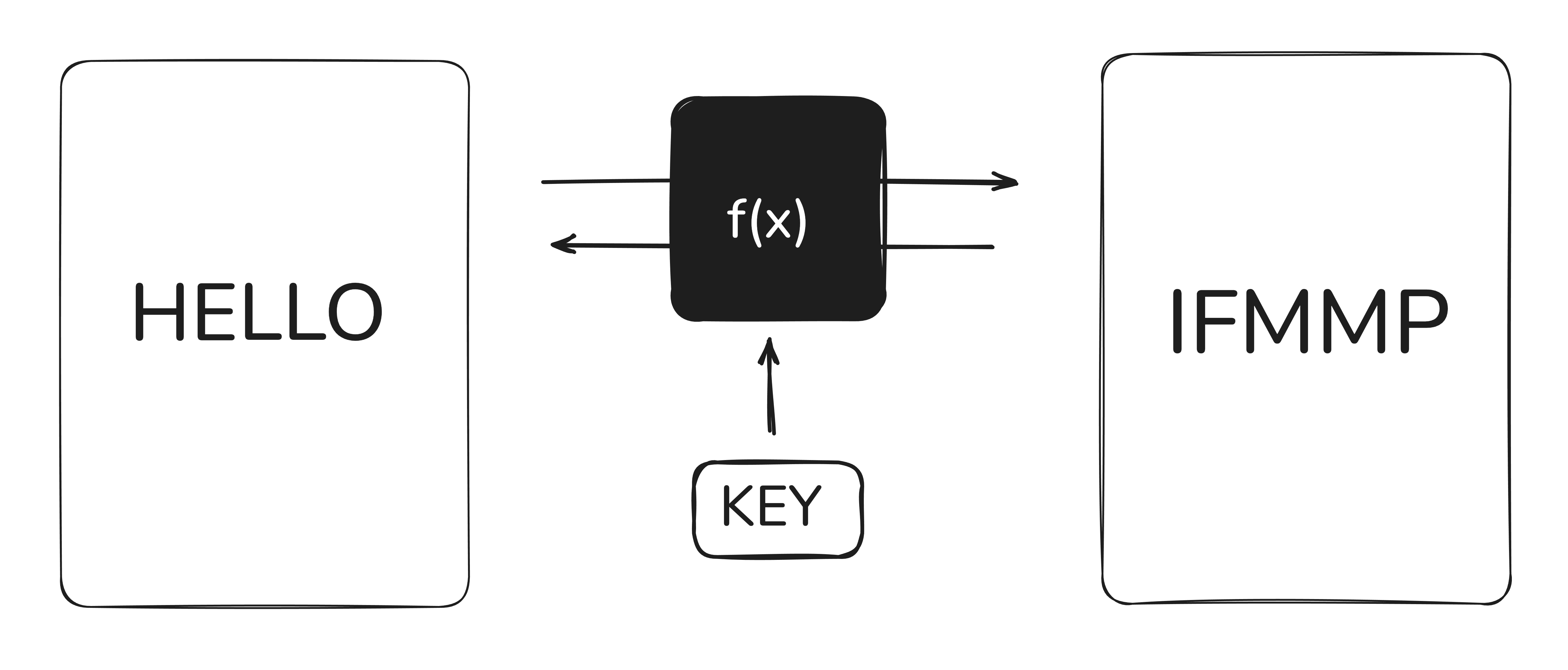
At a high level, all cryptographic algorithms work as follows:
- The unencrypted message is called plaintext.
- Plaintext is passed to an encryption function, which is a set of rules for transforming the message.
- The function also takes a key, known only to the sender and receiver.
- Using the key, the function produces the ciphertext (encrypted message).
It is crucial that the key and encryption method remain secret; otherwise, anyone can decrypt the message.
The Ciphertext
We are given the following ciphertext
psili nli cg bgli onllailm pg flgmm. nkk a snvi ac fgbbgc waps psi qcfgcplgkknoki ncr psi acmnci, psi vafagqm ncr psi ivak, nkk psi bnysib a snvi fnqmir ncr by qppil acraeeilicfi pgwnlr ap a snvi cgw mqlhnmmir. by hnac am fgcmpncp ncr msnlh ncr a rg cgp sghi egl n oippil wglkr egl ncygci, ac enfp a wncp by hnac pg oi acekafpir gc gpsilm. a wncp cg gci pg imfnhi, oqp ivic nepil nrbappacd psam psili am cg fnpsnlmam, by hqcamsbicp fgcpacqim pg ikqri bi ncr a dnac cg riihil ucgwkirdi ge bymike; cg ciw ucgwkirdi fnc oi ixplnfpir elgb by pikkacd. psam fgceimmagc snm bincp cgpsacd.
Uppercase letters denote letters that are decrypted and lowercase letters denote letters that are not.
Step 1: Initial Guesses
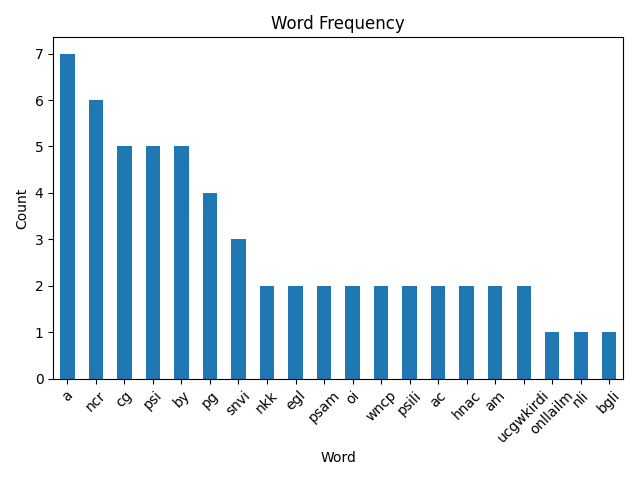
Observing the text, we notice frequent repetitions such as psi and ncr
. We can guess 2 common 3-letter words:
| Cipher | Likely Plaintext |
|---|---|
| psi | THE |
| ncr | AND |
Let's assign them:
p => T
s => H
i => E
n => A
c => N
r => D
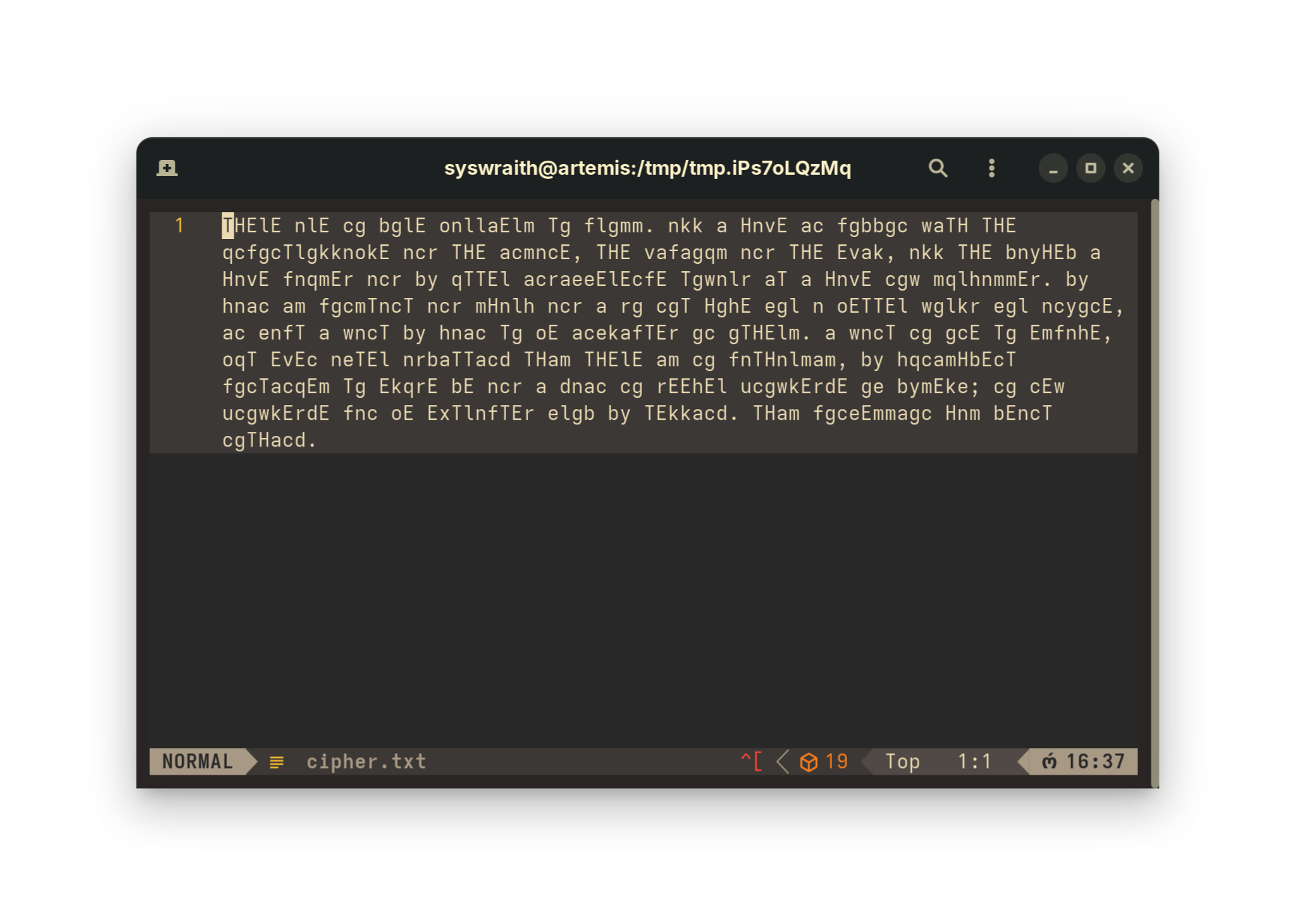 In the first word, if we change
l => R, we get the word THERE.
In the second word, if we change n => A, we get the word ARE.
l => R
n => A
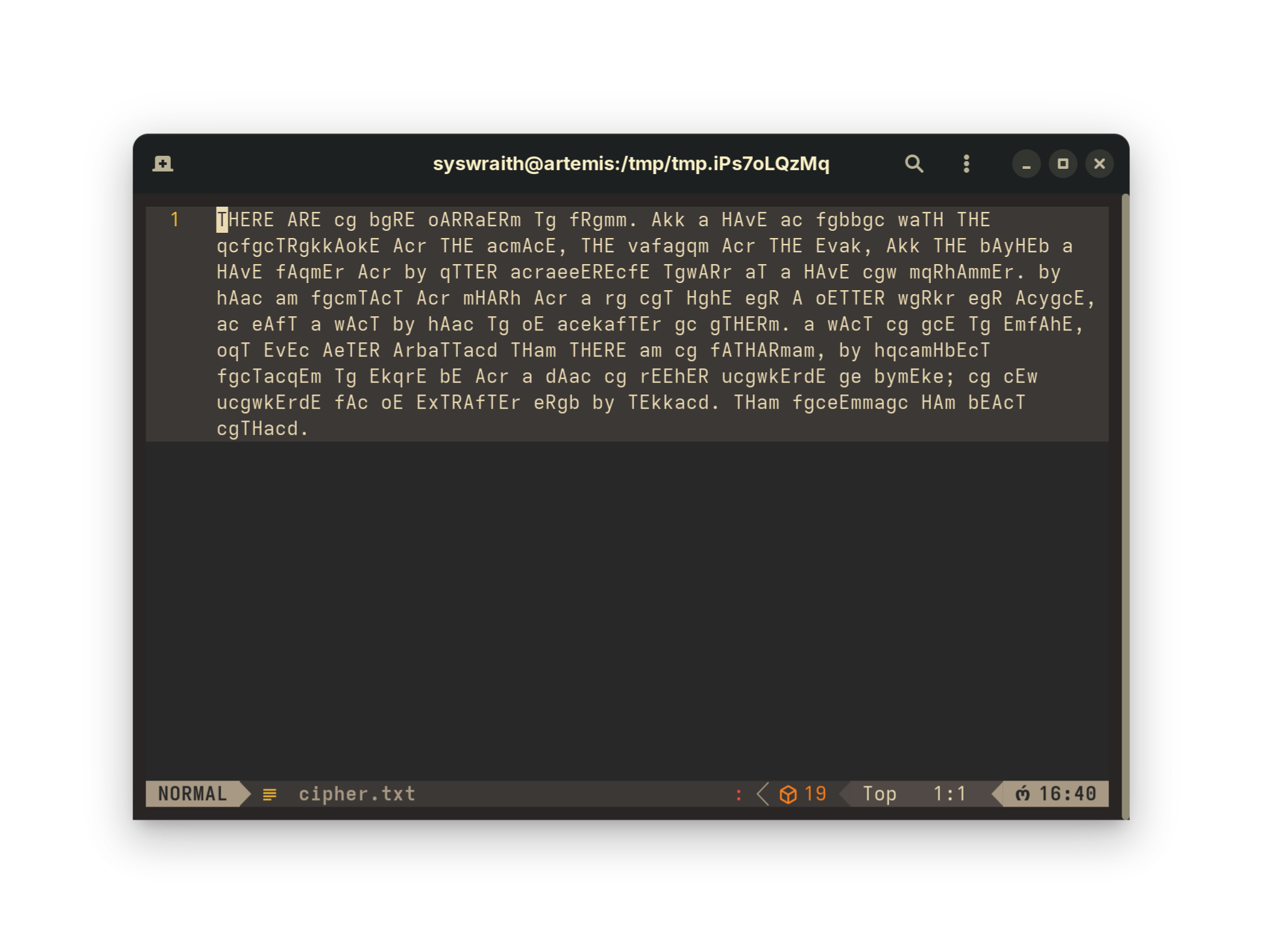
Step 2: Single-character Words
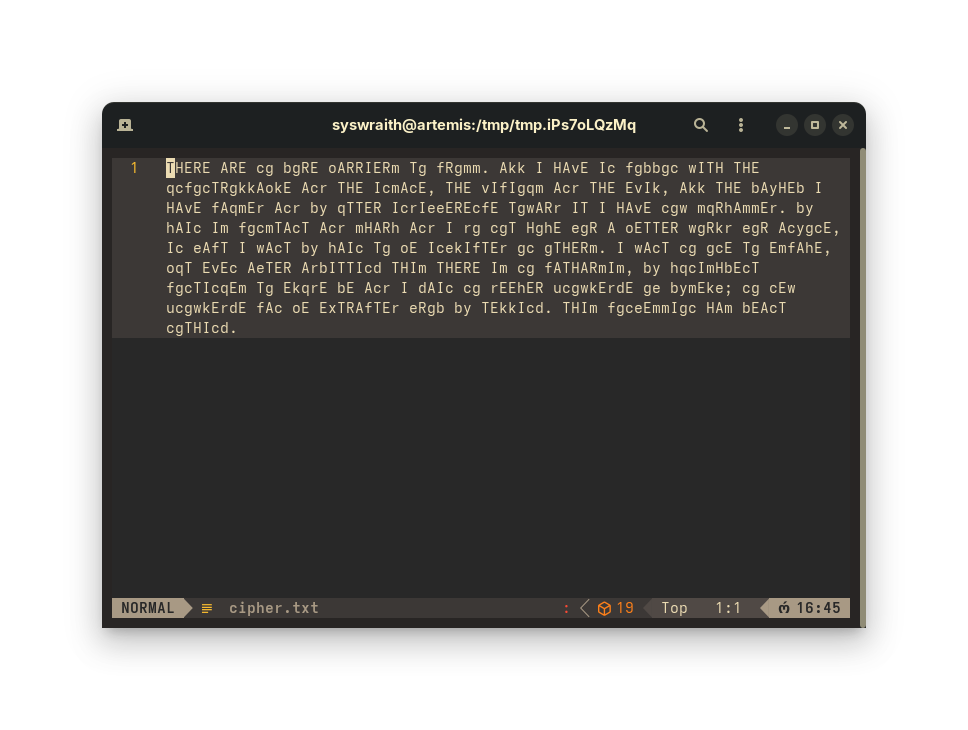
The character a comes by itself. There are two possibilities - A and I. Since A is already used, we replace it with:
a => I
Step 3: Recognizing Common Words
The phrase AND appears in context; we assign:
v => V
w => W
c => N
r => D
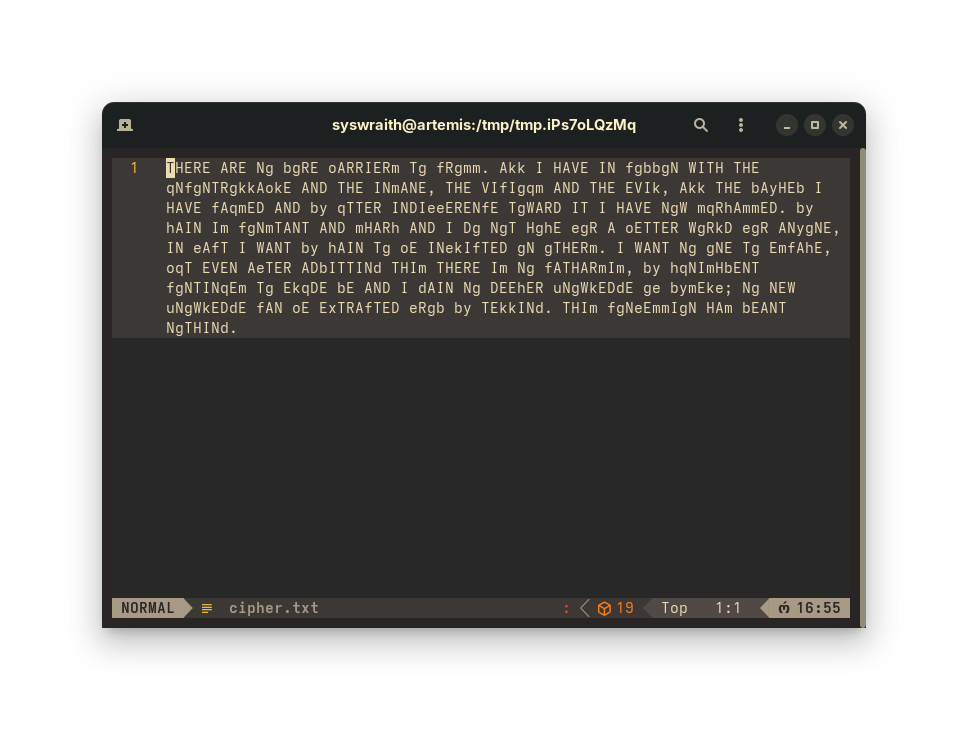 We can assume that since since v, w have their usual meanings, the letters coming after them follow this property as well.
x => X
y => Y
z => Z
Step 4: Repeating Letters
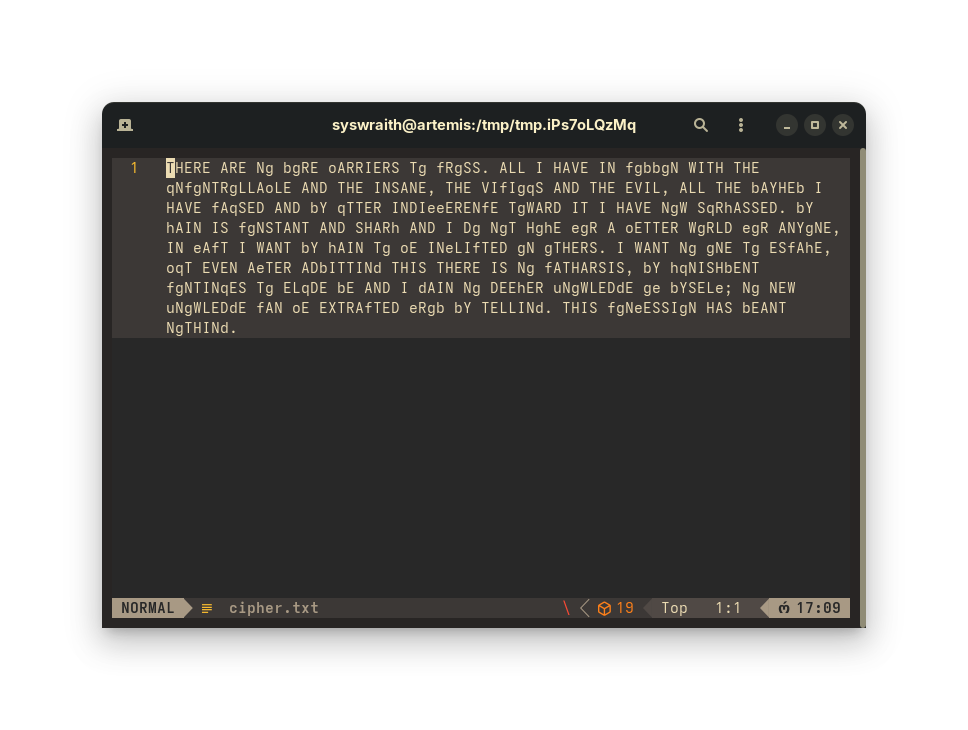
- Repeated ciphertext
kklikely is likelyllbecause ALL fits more in this context than ASS. m→Sto form the wordINSANE.
Step 5: Completing the Key
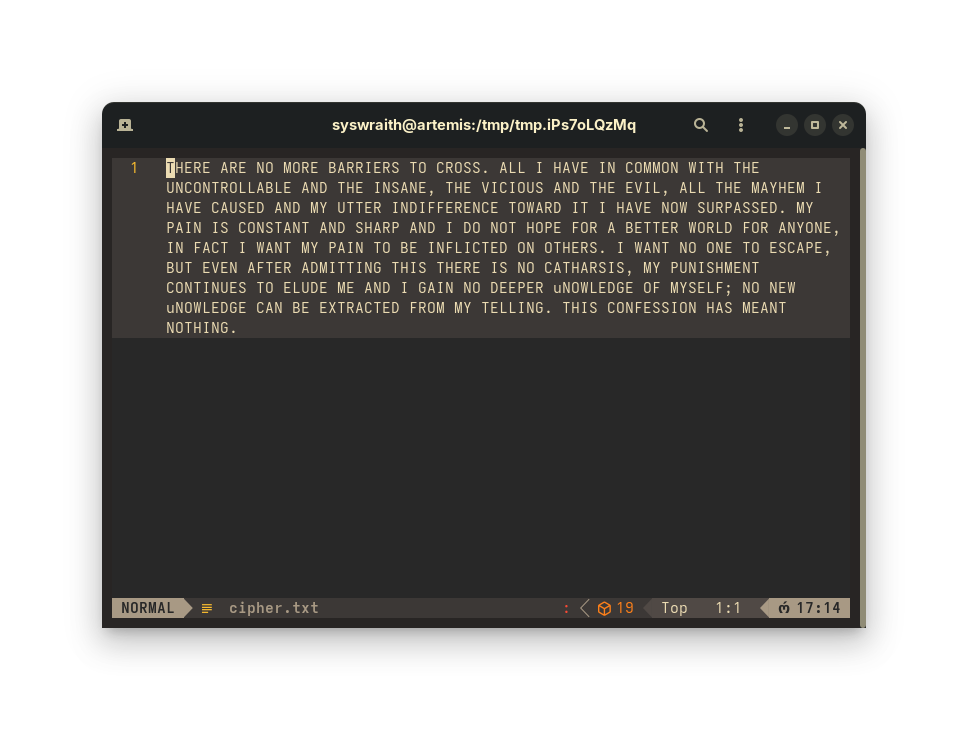
Based on context, we fill remaining letters:
g => O
b => M
o => B
q => U
h => P
d => G
f => C
e => F
Final Key
| Letter | a | b | c | d | e | f | g | h | i | j | k | l | m | n | o | p | q | r | s | t | u | v | w | x | y | z |
|---|---|---|---|---|---|---|---|---|---|---|---|---|---|---|---|---|---|---|---|---|---|---|---|---|---|---|
| Mapping | I | M | N | G | F | C | O | P | E | _ | _ | R | S | A | B | T | U | D | H | _ | _ | V | W | X | Y | Z |
Step 6: Frequency Analysis & Observations
- Observing repeating letters and common patterns (
THE,ARE,AND) helped identify substitutions. - Double letters (
ll,ss) give clues about word structure. - Context is key: guessing likely words makes solving faster.
Tips for Solving Substitution Ciphers
- Start with short, common words (
the,and,are,is). - Look for repeating patterns - double letters, common suffixes (
-ing,-ed). - Track mappings in a table. Sometimes one may be able to bruteforce the key used to encrypt the message, and then break the cipher that way.
- Analyze the frequency of letters. For example, letters like
E,T,Aappear often in English. - A good resource for more information on cryptography is The Code Book by Simon Singh.