<?xml version="1.0" encoding="utf-8"?>
<feed xmlns="http://www.w3.org/2005/Atom">
  <title>syswraith&#39;s notes</title>
  <id>http://syswraith.com/notes/</id>
  <link href="http://syswraith.com/notes/"/>
  <link rel="self" href="http://syswraith.com/notes/feed.xml"/>
  <updated>2026-11-24T05:19:41Z</updated>
  <entry>
    <id>http://syswraith.com/notes/6/</id>
    <title>Maybe it&#39;s time to go immutable soon</title>
    <link href="http://syswraith.com/notes/6/"/>
    <published>2026-11-24T05:18:15Z</published>
    <updated>2026-11-24T05:19:41Z</updated>
    <author><name>syswraith</name></author>
    <content type="html"><![CDATA[<p dir="auto">My CachyOS installation broke yesterday. Probably my fault. I remember updating my system, but I don't remember checking whether the update completed successfully. All my kernels were missing.</p>
<p dir="auto">Didn't have a USB stick lying around, and with exams coming up, I needed access to my notes and other files. Ended up spending 500 bucks on an 8GB microSD card, flashing CachyOS onto it, <code class="notranslate">chroot</code>-ing into my installation and reinstalling the kernel.</p>
<p dir="auto"><em>Pray to God, but row to shore.</em></p>
<p dir="auto">If I'm going to use a mutable distro, I should always have a bootable USB around for emergencies.</p>
<p dir="auto">This is one of the reasons immutable distros are appealing. Atomic updates, rollback capabilities, and a system that doesn't end up in a half-updated, unusable state.</p>
<p dir="auto">I've tried <a href="https://nixos.org/" rel="nofollow">NixOS</a> before, but couldn't get comfortable with it. Managing the entire system felt complicated, and I never stuck around long enough to learn the Nix language.</p>
<p dir="auto">Fedora's Atomic Desktops are looking pretty appealing right now. I feel icky about having bunch of preinstalled packages, though, so I'm considering building my own image with <a href="https://universal-blue.org/" rel="nofollow">Universal Blue</a> or <a href="https://blue-build.org/" rel="nofollow">BlueBuild</a>.</p>
<p dir="auto">I like the <code class="notranslate">rpm-ostree</code> approach and the idea of layering utilities onto the base system, almost like working with Docker containers.</p>
<p dir="auto">Need to do some more research before making the switch. Definitely not happening this week. Exams first.</p>]]></content>
  </entry>
  <entry>
    <id>http://syswraith.com/notes/5/</id>
    <title>Go Tabless on your browser!</title>
    <link href="http://syswraith.com/notes/5/"/>
    <published>2026-11-21T05:07:42Z</published>
    <updated>2026-11-21T05:11:51Z</updated>
    <author><name>syswraith</name></author>
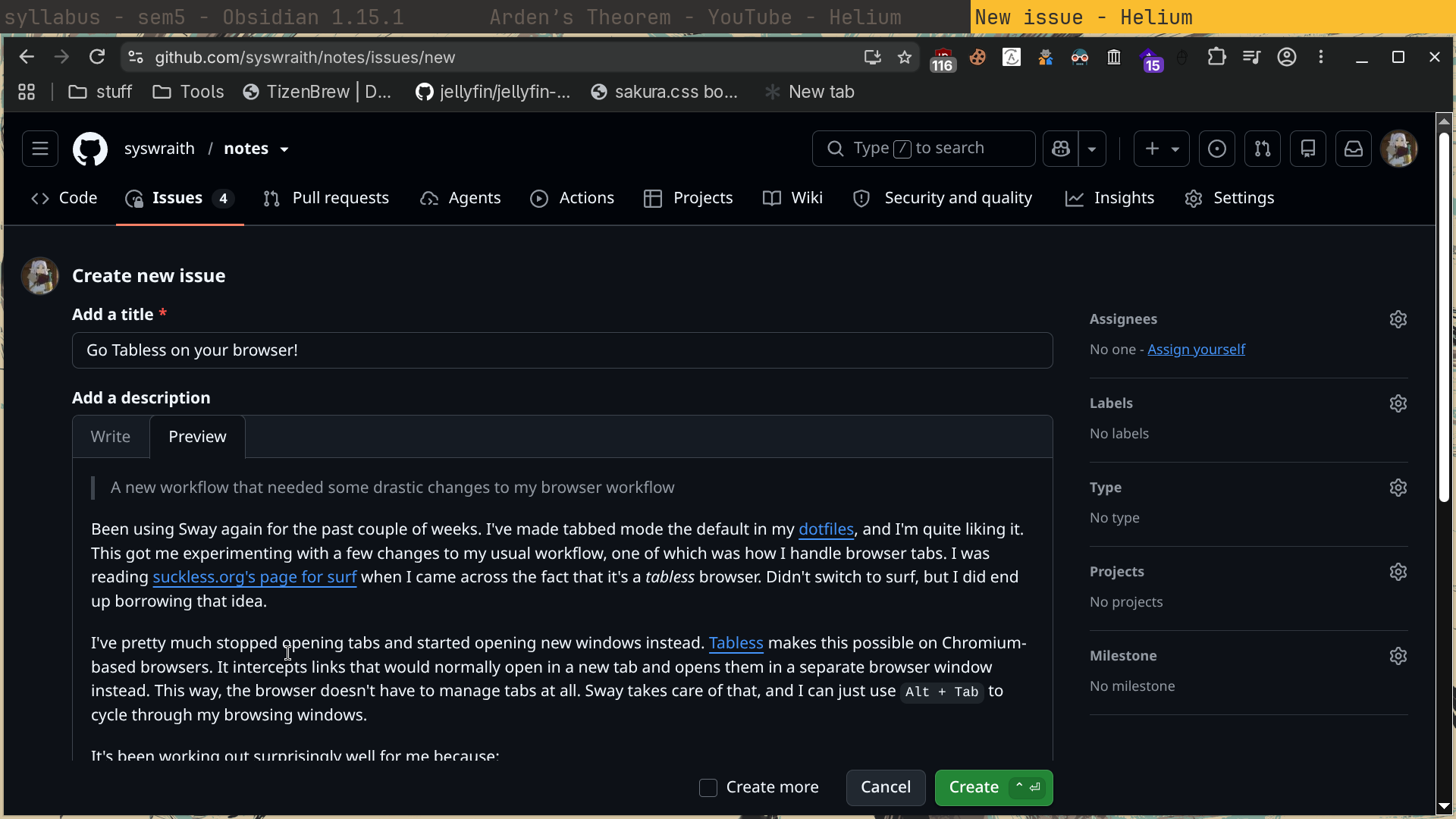
    <content type="html"><![CDATA[<p dir="auto">Been using Sway again for the past couple of weeks. I've made tabbed mode the default in my <a href="https://github.com/syswraith/dots">dotfiles</a>, and I'm quite liking it. This got me experimenting with a few changes to my usual workflow, one of which was how I handle browser tabs. I was reading <a href="https://surf.suckless.org/" rel="nofollow">suckless.org's page for surf</a> when I came across the fact that it's a <em>tabless</em> browser. Didn't switch to surf, but I did end up borrowing that idea.</p>
<p dir="auto">I've pretty much stopped opening tabs and started opening new windows instead. <a href="https://chromewebstore.google.com/detail/tab-less/mdndkociaebjkggmhnemegoegnbfbgoo" rel="nofollow">Tabless</a> makes this possible on Chromium-based browsers. It intercepts links that would normally open in a new tab and opens them in a separate browser window instead. This way, the browser doesn't have to manage tabs at all. Sway takes care of that, and I can just use <code class="notranslate">Alt + Tab</code> to cycle through my browsing windows.</p>
<p dir="auto">It's been working out surprisingly well for me because:</p>
<ul dir="auto">
<li>I don't end up with stale tabs at the end of a browsing session.</li>
<li>I don't use split tabs.</li>
<li>I can keep different browsing contexts in separate windows.</li>
<li>I can use Sway's tabbed layout to group windows and switch between them.</li>
</ul>
<p dir="auto">I'm keeping an eye on memory usage, but honestly, it hasn't been much of a bother.</p>
<p dir="auto">Oh, and you can also just switch to vertical tabs and avoid the existence of the browser's tab bar altogether 🙏</p>
<a target="_blank" rel="noopener noreferrer" href="http://syswraith.com/notes/5/images/2428963a0363ea2c.png"><img width="1920" height="1080" alt="image" src="http://syswraith.com/notes/5/images/2428963a0363ea2c.png" style="max-width: 100%; height: auto; max-height: 1080px;; aspect-ratio: 1920 / 1080; background-color: var(--bgColor-muted); border-radius: 6px" class="js-gh-image-fallback"></a>]]></content>
  </entry>
  <entry>
    <id>http://syswraith.com/notes/4/</id>
    <title>On Wanting a Simpler Web</title>
    <link href="http://syswraith.com/notes/4/"/>
    <published>2026-11-19T07:52:47Z</published>
    <updated>2026-11-22T19:37:55Z</updated>
    <author><name>syswraith</name></author>
    <content type="html"><![CDATA[<p dir="auto">When I was building <a href="https://github.com/syswraith/riff">riff</a>, I wanted things dead simple. My blog is a mess right now because I relied too much on <a href="https://help.obsidian.md/Editing+and+formatting/Obsidian+Flavored+Markdown" rel="nofollow">Obsidian-flavored Markdown</a> and <a href="https://help.obsidian.md/Linking+notes+and+files/Internal+links" rel="nofollow">wikilinks</a>, and wiring up cross-post links internally is a pain. Even with <a href="https://commonmark.org/" rel="nofollow">CommonMark</a>, only a tiny subset really feels suited for writing prose; <a href="https://daringfireball.net/projects/markdown/" rel="nofollow">Markdown</a> is honestly a pretty messy language to write in.</p>
<p dir="auto">The Markdown round-trip on the modern web makes this even funnier. <a href="https://blog.cloudflare.com/markdown-for-agents/" rel="nofollow">Cloudflare recently added an option</a> to serve Markdown to AI agents and normal pages to humans. It feels kind of absurd: we write posts in Markdown, compile them to HTML with an SSG, and then LLMs parse that HTML <em>back</em> into Markdown to read it. Why is HTML the mandatory middleman we have to go through?</p>
<p dir="auto">With styling, I feel like there's always a trade-off - too little kills the vibe, while too much tanks SEO and accessibility. My personal sweet spot is <a href="https://developer.mozilla.org/en-US/docs/Glossary/Semantics#semantics_in_html" rel="nofollow">semantic HTML</a> with <a href="https://css-tricks.com/no-class-css-frameworks/" rel="nofollow">classless stylesheets</a> and <a href="https://systemfontstack.com/" rel="nofollow">system fonts</a>, keeping things clean without turning the page into <code class="notranslate">div</code> soup.</p>
<p dir="auto">I'm also a big fan of only shipping a minimal light theme. Not because I like light mode, but because a clean light baseline is way easier to flip to dark. Most people I know use <a href="https://darkreader.org/" rel="nofollow">Dark Reader</a> by default anyway, and a simple light layout is much easier to tweak client-side with <a href="https://add0n.com/stylus.html" rel="nofollow">Stylus</a>.</p>
<p dir="auto">What I still don't get is why common styling tools like <a href="https://tailwindcss.com/" rel="nofollow">Tailwind</a>, <a href="https://styled-components.com/" rel="nofollow">styled-components</a>, or <a href="https://emotion.sh/" rel="nofollow">Emotion</a> aren't bundled into browsers natively. It seems like that would make page loads way faster - though honestly, even more than bundling frameworks, I just wish the web platform itself had better primitives in the first place.</p>
<a target="_blank" rel="noopener noreferrer" href="http://syswraith.com/notes/4/images/ba7c1090a822e0e4.png"><img width="88" height="31" alt="view on any browser" src="http://syswraith.com/notes/4/images/ba7c1090a822e0e4.png" style="max-width: 100%; height: auto; max-height: 31px;; aspect-ratio: 88 / 31; background-color: var(--bgColor-muted); border-radius: 6px" class="js-gh-image-fallback"></a>]]></content>
  </entry>
  <entry>
    <id>http://syswraith.com/notes/3/</id>
    <title>Vi supremacy in the Shell</title>
    <link href="http://syswraith.com/notes/3/"/>
    <published>2026-11-13T06:57:19Z</published>
    <updated>2026-11-13T06:59:11Z</updated>
    <author><name>syswraith</name></author>
    <content type="html"><![CDATA[<p dir="auto">Bash has an inbuilt <code class="notranslate">vi</code> mode that lets you use vi-styled keybinds instead of the usual emacs-styled ones.</p>
<p dir="auto">You can enable it by adding this one line to your <code class="notranslate">~/.bashrc</code>:</p>
<div class="highlight highlight-source-shell notranslate position-relative overflow-auto" dir="auto" data-snippet-clipboard-copy-content="set -o vi"><pre class="notranslate"><span class="pl-c1">set</span> -o vi</pre></div>
<p dir="auto">However, this doesn't tell you which mode you are in currently, so adding <a href="https://stackoverflow.com/questions/1039713/different-bash-prompt-for-different-vi-editing-mode" rel="nofollow">this line</a> will give you text indicators:</p>
<div class="highlight highlight-source-shell notranslate position-relative overflow-auto" dir="auto" data-snippet-clipboard-copy-content="set show-mode-in-prompt on"><pre class="notranslate"><span class="pl-c1">set</span> show-mode-in-prompt on</pre></div>
<p dir="auto">demo:</p>
<a target="_blank" rel="noopener noreferrer" href="http://syswraith.com/notes/3/images/e9ed1dcf81d149b1.png"><img width="536" height="328" alt="image" src="http://syswraith.com/notes/3/images/e9ed1dcf81d149b1.png" style="max-width: 100%; height: auto; max-height: 328px;; aspect-ratio: 536 / 328; background-color: var(--bgColor-muted); border-radius: 6px" class="js-gh-image-fallback"></a>]]></content>
  </entry>
  <entry>
    <id>http://syswraith.com/notes/2/</id>
    <title>Modern C is awesome!</title>
    <link href="http://syswraith.com/notes/2/"/>
    <published>2026-11-12T09:15:06Z</published>
    <updated>2026-11-12T09:41:38Z</updated>
    <author><name>syswraith</name></author>
    <content type="html"><![CDATA[<p dir="auto">Was reading the Wikipedia article for <a href="https://en.wikipedia.org/wiki/C23_(C_standard_revision)" rel="nofollow">C23</a> and <a href="https://en.wikipedia.org/wiki/C29_(C_standard_revision)" rel="nofollow">C29 (planned)</a>. Found some interesting features that I care about:</p>
<h1 dir="auto">C23</h1>
<ul dir="auto">
<li><code class="notranslate">auto</code> keyword to automatically infer types of variables (functions not supported)</li>
<li><code class="notranslate">true</code> and <code class="notranslate">false</code> as keywords, without <code class="notranslate">stdbool.h</code></li>
<li><code class="notranslate">typeof()</code> to give you the type of a variable</li>
<li><code class="notranslate">constexpr</code> for compile-time constants (no more macro abuse)</li>
<li><code class="notranslate">nullptr</code> keyword that can be used in place of <code class="notranslate">NULL</code></li>
<li><code class="notranslate">_BitInt(N)</code>  to give you at least <code class="notranslate">N</code> sized integers</li>
</ul>
<h1 dir="auto">C29</h1>
<ul dir="auto">
<li><code class="notranslate">_Countof</code> keyword and  <code class="notranslate">countof</code> macro that determine the number of elements of an array (no need for <code class="notranslate">sizeof(arr)/sizeof(arr[0])</code> now)</li>
<li><code class="notranslate">defer</code> keyword and blocks for cleanup!</li>
<li><code class="notranslate">case</code> ranges like <code class="notranslate">case 1 ... 3:</code></li>
</ul>
<p dir="auto">Obviously, there a ton more which I don't know/use. GCC 15 and Clang 19 already include an experimental flag to enable support for C29. Time for another recreational programming session soon.</p>]]></content>
  </entry>
  <entry>
    <id>http://syswraith.com/notes/1/</id>
    <title>Thoughts on microblogging</title>
    <link href="http://syswraith.com/notes/1/"/>
    <published>2026-11-11T15:25:08Z</published>
    <updated>2026-11-19T07:57:05Z</updated>
    <author><name>syswraith</name></author>
    <content type="html"><![CDATA[<p dir="auto">I am not happy with the state of my blog right now. I migrated away from <a href="https://quartz.jzhao.xyz/" rel="nofollow">quartz</a> to <a href="https://www.11ty.dev/" rel="nofollow">eleventy</a> and locally tried out <a href="https://gohugo.io/" rel="nofollow">hugo</a> and <a href="https://www.getzola.org/" rel="nofollow">zola</a>. This may be a skill issue but I found some level of complexity in all of them.</p>
<p dir="auto">Then I read <a href="https://shashwatagrawal20.github.io/portfolio/posts/i-publish-from-github-issues-and-your-cms-is-theater.html" rel="nofollow">this blogpost by oomf</a> and reflected on the way I was doing things. Making a post small enough to be twitter thread also helps me be concise and cut out the crap.</p>
<p dir="auto">With this in mind, I made <em><a href="https://github.com/syswraith/riff">riff</a></em>. It's hand-rolled and GitHub Issues driven. It supports markdown, latex and syntax highlighting. It has a dumbed-down UI that isn't gruvbox.</p>
<p dir="auto">I think this is what I'm looking for right now. I'll still use blogs when I want to be more verbose, but this is for random thoughts I get when I'm not writing a thesis.</p>]]></content>
  </entry>
</feed>